
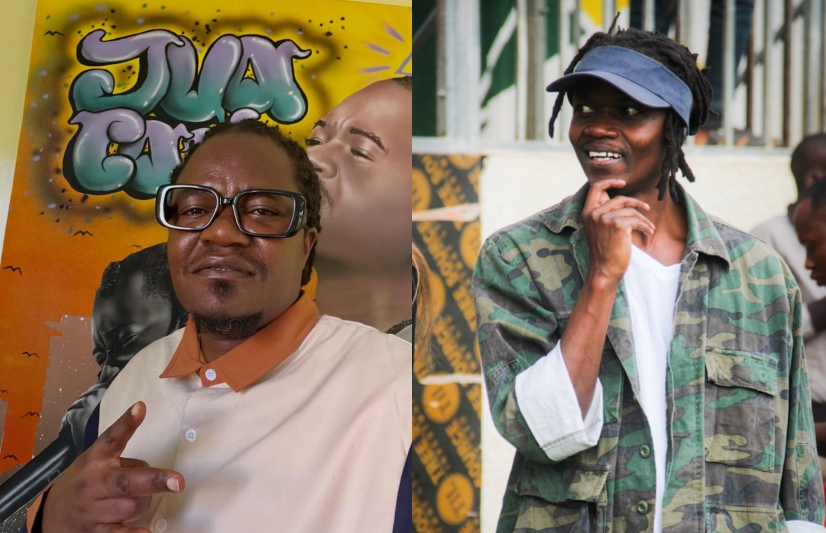
In the world of Kenyan music, few voices carry as much weight as Juliani’s—and he has just used that weight to settle the “G.O.A.T.” debate once and for all.
During a soul-baring interview on Thursday, February 19, 2026, the Exponential Potential rapper bypassed modern chart-toppers to name veteran Genge pioneer Jua Cali as the single most significant artiste the country has ever produced.
For Juliani, it isn’t just about the hits; it’s about the cultural “shutdown” that Jua Cali mastered like no one else.
Juliani, who emerged from the legendary Ukoo Fulani Mau Mau camp, argued that Jua Cali was the bridge that allowed Kenyan musicians to be viewed as actual celebrities rather than just local performers.
“In my opinion, Jua Cali is the biggest artist ever in Kenya,” Juliani stated.
“There’s never been an artist who was able to shutdown the ground. He’s the one who transitioned us to celebrity status.”
View this post on Instagram
Even in the age of viral TikTok hits and international streaming, Juliani insists that the “King of Genge” possessed a raw, grassroots influence that remains the gold standard for anyone trying to dominate the “ground.”
The interview took a deeper, more personal turn as Juliani reflected on his own upbringing in Nairobi’s toughest neighborhoods.
Long before he was a household name, Juliani revealed that music was quite literally his lifeline.
“You wake up in the morning, and you hear gunshots. Someone is killed,” he recounted.
“Most people get into crime. But for me, the lyrics were therapy. Music or art is the most powerful tool you can ever use to develop a society.”
While Juliani is often categorized as a “gospel” rapper, he used the platform to distance himself from being boxed in.

Describing himself as a seeker rather than a preacher, he noted that his lyrics were always about trying to understand life’s “why” rather than delivering finished “conclusions.”
With upcoming projects spanning from House music to Live Rock, Juliani is proving that while Jua Cali may have defined the “celebrity,” he is the one defining the “ever-changing canvas” of Kenyan art.