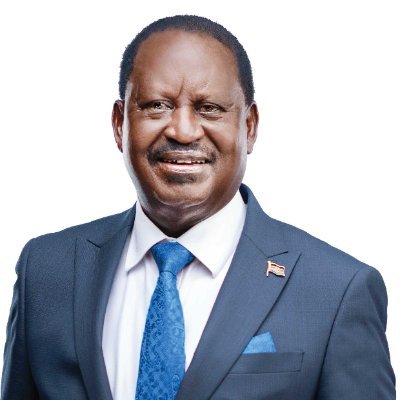
Raila Amolo Odinga’s story is inextricably woven into the very fabric of Kenya’s political evolution — a tale of resilience, vision, betrayal, and undying belief in democracy. Born on January 7, 1945, in Maseno, Kisumu District, Raila was destined for a life of both privilege and struggle. His father, Jaramogi Oginga Odinga, was a key figure in Kenya’s independence movement and the nation’s first Vice President. From an early age, Raila’s path was shaped by the ideals of social justice and the conviction that leadership meant service — not power.
Raila’s education began at Maranda Primary and Secondary Schools, institutions that would later produce several prominent Kenyan leaders. He later attended the prestigious Herder Institute in East Germany and then the Magdeburg University of Technology (now Otto von Guericke University), where he earned a Master’s degree in Mechanical Engineering. His time abroad exposed him to socialist thought, political activism, and Pan-African ideals, all of which would define his ideological compass for decades to come. It was in East Germany that he also met Ida Betty Anyango, who would become his lifelong partner, a teacher, and one of the most respected women in Kenyan public life.
Upon returning to Kenya in the early 1970s, Raila took up a teaching post at the University of Nairobi before moving into business, founding the East African Spectre, a gas cylinder manufacturing company that still stands as one of the few indigenous industrial ventures of its kind in Kenya. But politics was in his blood, and by the late 1970s, he was quietly aligning himself with opposition movements that were challenging the authoritarian rule of President Daniel arap Moi. This was dangerous territory, and by the early 1980s, Raila found himself accused of being part of the 1982 coup attempt against Moi’s government.
The coup attempt changed everything. Raila was detained without trial for six long years — from 1982 to 1988 — under brutal conditions. He was tortured, kept in solitary confinement, and denied access to his family. Yet he emerged from detention unbroken, even stronger. His resilience during those dark years became the foundation of his political mythos — the man who suffered for Kenya’s freedom. He was re-arrested twice thereafter — in 1989 and 1990 — for his continued involvement in pro-democracy movements alongside other reformists like Kenneth Matiba, Charles Rubia, and his close ally James Orengo. By the time Kenya returned to multiparty democracy in 1991, Raila Odinga was already a political heavyweight, a living symbol of resistance.
Read also: Bahati drops ‘Fire’ song featuring Raila Odinga
In 1992, he joined the Forum for the Restoration of Democracy (FORD), founded by his father Jaramogi, and later FORD-Kenya after the movement split. When Jaramogi passed away in 1994, Raila sought to inherit his father’s mantle but was edged out by internal party politics. In 1997, he ran for president under the National Development Party (NDP), finishing third but cementing his status as a national figure. He later struck a surprising alliance with President Moi, merging NDP with the ruling KANU in 2001. This alliance, while controversial, positioned him as Minister of Energy and allowed him to gain invaluable experience in government. But the partnership soured as Moi attempted to impose Uhuru Kenyatta as his successor. Raila famously led the KANU rebels, the so-called “Rainbow Alliance,” out of the party — a move that reshaped Kenya’s political future.
In 2002, Raila was instrumental in forming the National Rainbow Coalition (NARC) that swept Mwai Kibaki to power, ending KANU’s 39-year rule. His famous declaration “Kibaki Tosha!” at Uhuru Park remains one of the most iconic political moments in Kenya’s history. Yet, what began as a partnership of reform soon crumbled under the weight of political betrayal. The 2005 constitutional referendum divided the government, with Raila leading the “Orange” campaign against the proposed draft — giving birth to the Orange Democratic Movement (ODM), which became his political vehicle and the most powerful opposition movement Kenya has ever seen.
The 2007 presidential election marked a dark chapter in Kenya’s history. Raila was widely believed to have won the election against incumbent Mwai Kibaki, but the results were disputed, sparking nationwide violence that claimed over 1,300 lives. It was a moment that tested the soul of the nation. Under intense international mediation led by Kofi Annan, a power-sharing agreement was reached. Raila was appointed Prime Minister in 2008 under the Grand Coalition Government — a role in which he proved his administrative mettle. He oversaw major reforms in infrastructure, energy, and governance, pushing for modernization and transparency. His tenure saw the beginning of Vision 2030’s implementation and the introduction of performance contracts in government ministries — reforms that still shape Kenya’s public service ethos.
Raila’s political career thereafter became a series of near-misses that defined Kenya’s democratic struggle. He ran again for president in 2013, 2017, and 2022 — each time losing amid allegations of rigging and electoral malpractice. In 2017, after the Supreme Court nullified the presidential results — the first such ruling in Africa — Raila boycotted the rerun, declaring himself the “People’s President” in a symbolic swearing-in at Uhuru Park in January 2018. That act of defiance would later lead to the unexpected “Handshake” with President Uhuru Kenyatta, a truce that calmed political tensions and birthed the Building Bridges Initiative (BBI), aimed at addressing ethnic divisions and constitutional reforms. Though BBI failed to materialize, the handshake marked a pivotal chapter in Kenya’s attempt at national unity.
Raila’s family has been the quiet backbone behind his endurance. His wife Ida Odinga, often called the matriarch of democracy, has been a symbol of grace, education, and women’s empowerment. Their children — Fidel (now deceased), Rosemary, Raila Jr., and Winnie — have carried the Odinga legacy in different ways. Fidel’s death in 2015 was a devastating blow that humanized Raila to even his fiercest critics. Rosemary’s health struggles and recovery, Winnie’s emergence as his political protégé, and Ida’s unwavering presence all reflect a family built on resilience and purpose.
Raila’s influence extends beyond elections. He is a statesman whose advocacy for democracy in Africa has earned him global respect. He served as the African Union High Representative for Infrastructure Development, promoting connectivity and integration across the continent. His vision for a modern, equitable Kenya — where institutions matter more than tribes — remains one of the most transformative ideas in post-colonial East Africa.
Whether one loves or opposes him, Raila Odinga’s legacy is undeniable. He is the opposition leader who became a symbol of national conscience, the prisoner who turned his pain into purpose, the reformist who forced Kenya’s political class to reckon with accountability, and the eternal candidate who never stopped believing in the dream of a better Kenya. He will be remembered as the man who redefined what it means to fight for democracy — a man whose political journey was not about personal victory, but about expanding the democratic space for generations to come.
In the twilight of his life, Raila Odinga remains an enigma — part revolutionary, part statesman, part myth. But to millions, he is “Baba” — the father figure who bore the burden of a nation’s democratic struggle on his back. His legacy will live on not in the offices he held or the elections he lost, but in the spirit of courage and conviction he ignited in Kenya’s collective soul.